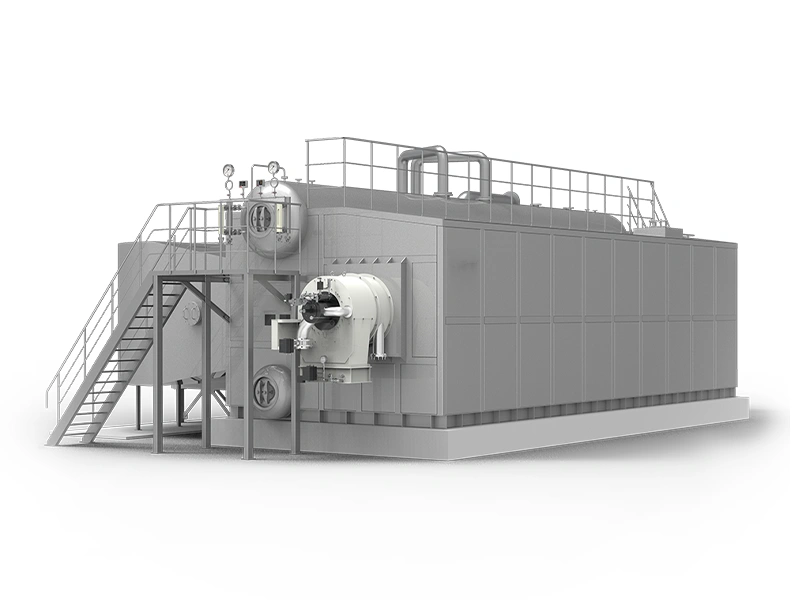
Our WNS Series fully condensing steam/hot water boilers use low-temperature water to exchange heat with flue gas. This process reduces the flue gas temperature to the point where the water vapor in the gas condenses into liquid water, releasing latent heat of vaporization. The higher the condensation rate, the higher the corresponding boiler efficiency. Check out our parameters for steam boiler and hot water boiler.
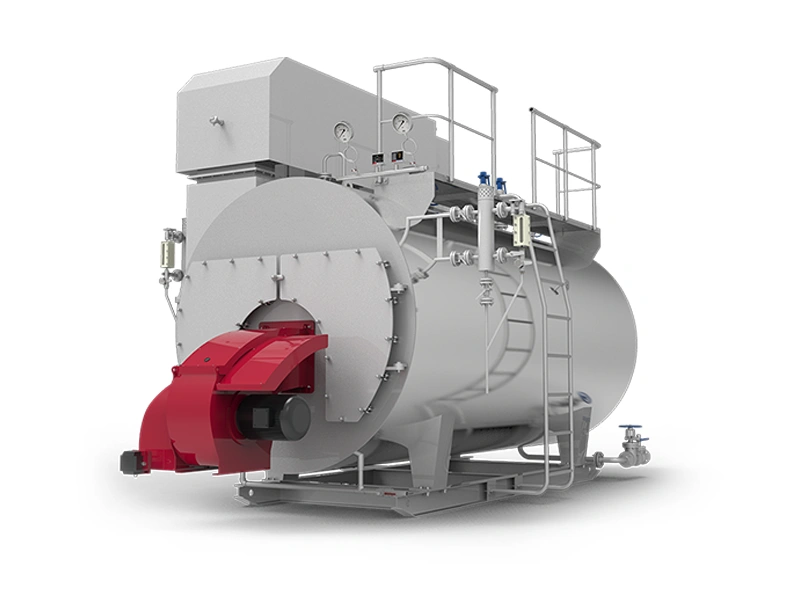
| Steam boiler technical parameters | |
|---|---|
| Model | WNS1~20 (horizontal) |
| Rated steam pressure | 1.0~2.5MPa |
| Rated evaporation | 1-20T/H |
| Hot water boiler technical parameters | |
| Model | WNS0.7-14 (horizontal) |
| Rated working pressure | 1.0~2.5MPa |
| Rated thermal power | 0.7-14MW |
WNS Series Fully Condensing Steam Boiler |
|
| Model | WNS1~20 |
| Operating Pressure | 1.0–2.0 MPa |
| Rated Evaporation Capacity | 1–20 t/h |
WNS Series Fully Condensing Hot Water Boiler |
|
| Model | WNS0.7~14 |
| Operating Pressure | 1.0~1.6 MPa |
| Rated Thermal Power | 0.7~14 MW |
Applicable Fuels |
|
| Natural Gas | |
| City Gas | |
| Light Diesel | |
Energy-Saving Configurations |
|
| Economizer + Condenser | |
| Boiler Thermal Efficiency | ≥100% |
| Flue Gas Temperature | ≤60℃Economizer + Air Preheater (Condensate Recovery) |
| Boiler Thermal Efficiency | ≥95% |
| Flue Gas Temperature | ≤100℃Economizer + Air Preheater + Condenser (Condensate Recovery) |
| Boiler Thermal Efficiency | ≥98% |
| Flue Gas Temperature | ≤70℃ |
The above configurations for different boilers are available based on your requirements, and the results are the same, significantly improving boiler thermal efficiency and reducing flue gas temperatures.
To further enhance boiler efficiency and reduce energy waste, we designed an integrated condensing economizer.
Both the economizer and condenser utilize finned tubes as heat exchange tubes. The system employs a partition-type heat exchange principle, where water flows inside the finned tubes and flue gas flows outside. Through convective heat exchange, the system maximizes the absorption of sensible heat from the flue gas and the latent heat released during water vapor condensation, greatly enhancing boiler thermal efficiency and promoting energy conservation and emission reduction.
Two-Pass Boiler Body Structure: Reduces system resistance without requiring increased burner power.
Economizer and Condenser Placement: Located at the top of the boiler for efficient heat recovery.
Compact Design: Integrated structure with an aesthetically pleasing appearance, minimal footprint, and space-saving layo
1. Industrial production
Chemical, building materials, pharmaceuticals and other industries: used for process heating, steam supply and equipment disinfection. Suitable for steam demand in the chemical industry, emphasizing its application in factory process hot water and industrial production.
Food processing and packaging: The boiler provides stable steam and hot water to meet the needs of sterilization, cleaning, etc.
2. Commercial and civilian heating
Central heating: widely used for winter heating in residential areas, office buildings, hotels, and other fields.
Sanitary hot water supply: The hot water demand of hotels, swimming pools, and commercial places is efficiently supplied through a closed-loop water system.
3. Energy and Public Services
Auxiliary power generation in thermal power plants: Large boilers (such as 35 ton models) can provide thermal support for thermal power plants.
Hospitals and schools: Ensure the stability of heating and hot water supply while meeting environmental requirements.
1. Outstanding environmental performance
Ultra low nitrogen emissions: By using technologies such as premixed combustion and flue gas recirculation (FGR), NOx emissions can be reduced to below 30mg/m ³, far below the national standard of 50mg/m ³.
Flue gas waste heat recovery: 15% -20% of waste heat is recovered through condensers and energy-saving devices to reduce energy waste.
2. Efficient and energy-saving
Thermal efficiency reaches 99%: Optimized furnace design (such as waveform furnace liner, threaded smoke tube) and combustion control technology significantly improve thermal conversion efficiency.
Reduce fuel costs by 10% -15%: The intelligent control system automatically adjusts fuel and air volume according to load, and the case shows an annual savings of 120000 cubic meters of natural gas.
3. Security and Intelligence
Multiple safety protections: equipped with automatic protection functions such as water shortage, overpressure, shutdown, and gas leakage to ensure safe operation.
Fully automatic control: supports remote monitoring and program start stop, reduces manual intervention, and improves stability.
4. Structural design and adaptability
Modular and compact design: Vertical or horizontal structures save space and are easy to install and maintain.
Strong fuel compatibility: It can adapt to various fuels such as natural gas, liquefied gas, and light diesel to meet the needs of different scenarios.
5. Economic benefits and policy support
Reduced operating costs: Annual maintenance costs are reduced by 20% -30%, and the water-saving rate is ≥ 95%.
Compliance with the "dual carbon" policy: Enterprises can enjoy environmental subsidies to avoid the risk of fines due to excessive emissions.
Low nitrogen fuel gas steam hot water boilers are widely used in industrial, commercial, and civilian fields. Their environmental friendliness, efficiency, and intelligence make them an ideal alternative to traditional boilers. With the tightening of environmental policies, its market demand will further expand, helping enterprises achieve green transformation.

Energy Engineering EPC Professional Service Provider




 中文
中文